
White paper ·
Driving Cost Efficiency in Higher Education: Strategic Approaches for Sustainable Savings
Practical Strategies for Procurement Optimization and Organizational Transformation
Dr. Rachel Frautschy DeMuth
Higher education institutions face mounting financial pressures driven by declining enrollments, rising operational costs, and increased demand for digital transformation. This whitepaper outlines actionable strategies to achieve sustainable cost efficiencies through operational redesign and external partnerships.
All publications Download PDFExecutive Summary
Higher education institutions face mounting financial pressures driven by declining enrollments, rising operational costs, and increased demand for digital transformation. This whitepaper outlines actionable strategies to achieve sustainable cost efficiencies through operational redesign and external partnerships.
Key Takeaways
- Cost Pressures In Higher Education Are Structural,
Not Temporary. Declining Enrollments And Rising
Operating Costs Require Systemic
Transformation—Not Incremental Cuts—To Achieve
Sustainable Financial Health. - Process Optimization Delivers The Greatest And
Fastest Savings. Centralizing Procurement And
Redesigning Administrative Processes Can Reduce
Costs By 10–15% Annually While Improving
Compliance And Governance. - Technology Alone Is Insufficient Without
Organizational Change. Digital Tools And
Automation Generate Value Only When Paired With
Leadership Alignment, Workforce Readiness, And
Redesigned Processes. - External Expertise Significantly Improves
Transformation Success. Institutions That
Leverage External Partners Achieve More Than
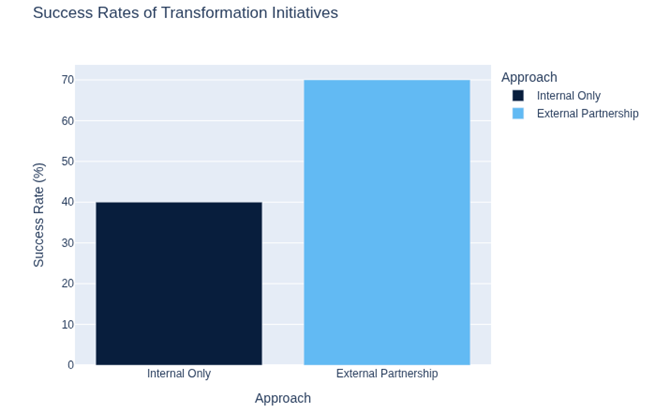
Double The Success Rate Of Internal-Only Efforts
By Accelerating Execution And Reducing Risk.
Introduction
Institutions are navigating unprecedented challenges, requiring bold approaches to cost containment and service delivery. According to the State Higher Education Executive Officers Association (SHEEO), inflation-adjusted educational appropriations have declined by 6% over the past decade, while at the same time institutions are facing enrollment declines and rising operational costs. These pressures are driving cost containment to the top of strategic priorities (SHEEO, 2024).
Why does this matter now? Institutions that fail to act risk structural deficits, reduced program offerings, and reputational harm. Organizational transformation—streamlining procurement, consolidating administrative functions, leveraging shared services, and improving governance—is essential for sustainability. Research from Deloitte (2023) indicates that organizations leveraging external expertise achieve transformation success rates up to 30% higher than those relying solely on internal resources.
Objective of this Paper: Equip leaders with insights into common organizational challenges and provide practical considerations for engaging external expertise to accelerate success and reduce risk.
Core Challenge
Traditional cost-cutting measures often fail to deliver sustainable results. Instead, systemic change—supported by robust governance and specialized expertise—is essential for long-term impact. Many institutions recognize symptoms of inefficiency but struggle to identify root causes.
Symptoms vs. Root Causes
Symptoms often include:
- Escalating operational costs despite cost-cutting efforts
- Fragmented procurement processes and redundant vendor contracts
- Low employee engagement and resistance to organizational change
These symptoms typically stem from deeper root causes:
- Limited internal bandwidth and competing priorities
- Lack of specialized expertise in change management and process redesign
- Cultural inertia and fear of disruption
Understanding these dynamics is critical because they directly impact institutional performance and financial health.
Impact
The consequences are significant. McKinsey reports that 70% of large-scale change programs fail due to insufficient change management and leadership alignment (Aiken & Keller, 2023). In higher education, this can translate into millions in wasted resources and delayed strategic initiatives.
Strategic Insights
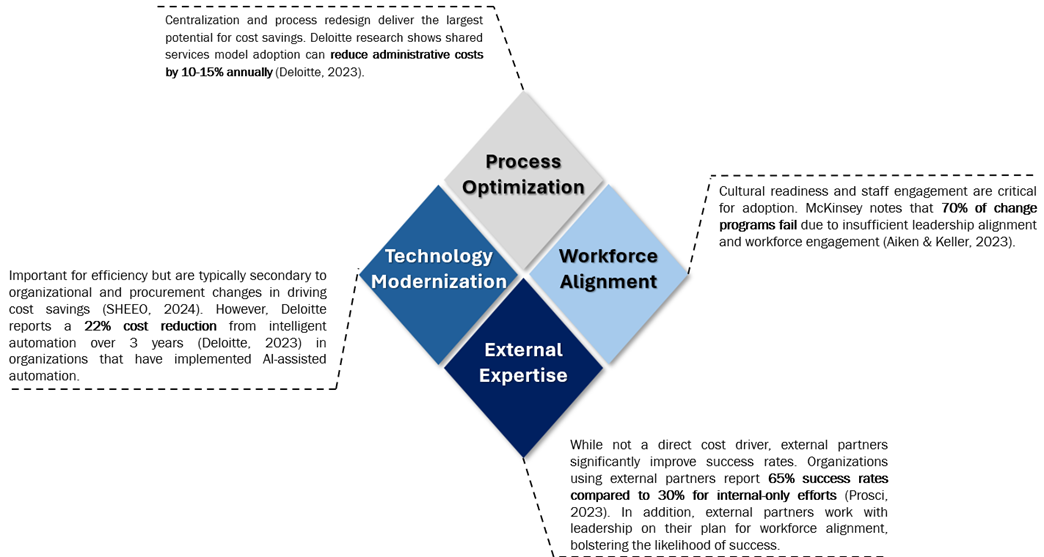
Research and industry benchmarks highlight several key drivers of successful transformation including leadership alignment, data-driven decision-making, and external partnerships. The following four insights are critical to consider when considering cost optimization initiatives.
References
References
Aiken, C. & Keller, S. (2023). The irrational side of change management. Retrieved from https://www.mckinsey.com/business-functions/organization/our-insights/the-irrational-side-of-change-management
Deloitte. (2023). Transforming Work in Higher Education: Rethinking How Administrative Functions are Delivered. Retrieved from https://www.deloitte.com/content/dam/assets-zone3/us/en/docs/industries/government-public-services/2024/us-gps-transforming-work-in-higher-education.pdf
Doolittle, N. (2015). Procurement services exceeds $30 million savings goal. Cornell Chronicle. Retrieved from https://news.cornell.edu/stories/2015/03/procurement-services-exceeds-30-million-savings-goal
Eggers, W. D., Salzetti, J., & McGrath, B. (2023). The nine trends reshaping government in 2023.Retrieved from https://www.deloitte.com/us/en/insights/industry/government-public-sector-services/government-trends/2023/cross-agency-collaboration.html
Negrea, S. (2013). Spend and save: Indiana University consolidates purchasing. Spaces4Learning. Retrieved from https://spaces4learning.com/articles/2013/03/01/spend-and-save.aspx
Prosci. (2023). Best Practices in Change Management. Retrieved from https://empower.prosci.com/best-practices-change-management-executive-summary
SHEEO. (2024). State Higher Education Finance Report.